

Sea-Intelligence (Jul 15th, 2026) – Structural Contraction of Global Liner Networks
Updated: Jul 31

The latest growth projections by IMF in their July 2026 update to the World Economic Outlook (WEO) report, indicate a steep deceleration in global trade volume growth, dropping from 5.0% in 2025 to 3.5% in 2026.
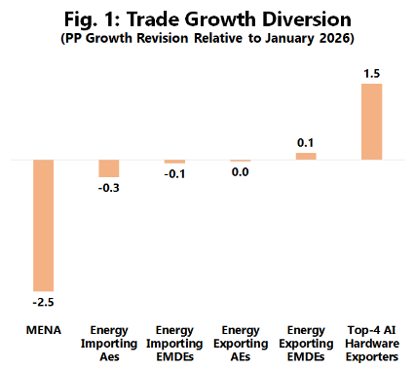
This slowdown is heavily influenced by prior front‑loading of cargo by shippers, the dampening macroeconomic effect of global tariffs, and the ongoing logistical hurdles surrounding the geopolitically impacted regions. Furthermore, economies integrated into the artificial intelligence (AI) value chain are experiencing a significant, technology‑driven boom, with the top four net exporters of AI‑related hardware – Taiwan, South Korea, Thailand, and Malaysia – receiving significant upward revisions to their growth forecasts (Figure 1). Conversely, traditional consumer‑facing trade lanes into Europe and North America face weakening fundamentals, dragged down by sluggish domestic consumer spending and elevated energy prices, among other issues.
Compounding these structural challenges is the optimistic nature of the IMF's baseline timeline, which assumes a phased reopening of the Strait of Hormuz beginning in mid‑July 2026. Given recent escalations, this timeline appears highly unlikely. The maritime industry needs to brace for prolonged network disruptions, structural supply bottlenecks, and rising energy prices throughout 2026.
To navigate these hurdles, shipping lines will need to remain agile, aligning available capacity with the technology corridors of Intra‑Asia and the Transpacific, while rightsizing networks bound for sluggish retail markets of Europe and North America.
--- 000 --- END OF PRESS RELEASE --- 000 ---
All quotes can be attributed to: Alan Murphy, CEO, Sea-Intelligence.


Comments