

Sea-Intelligence (Sept 16th, 2026) – Red Sea Crisis is 27% normalized.

In Issue 782 of the Sunday Spotlight, we used data from our Trade Capacity Outlook database to identify the exact Asia-Europe container vessels that have been routed through the Red Sea in recent weeks or are scheduled to do so in the coming weeks, as the container shipping industry is starting to normalise a return to the Suez Canal, from the round-Africa routing that has been the standard since the onset of the Red Sea crisis in December 2023.
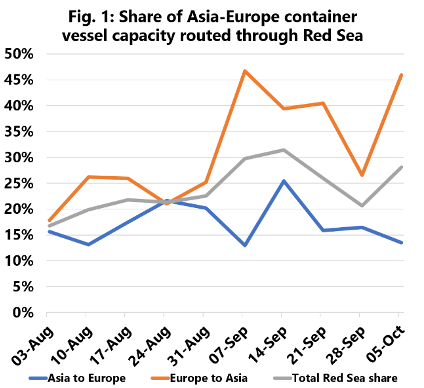
Figure 1 shows the share of container vessel capacity being routed through the Red Sea/Suez Canal for the head-haul direction from Asia to Europe, the Europe to Asia back-haul, as well as the combined share across the two directions. While the head-haul remains relatively stable at a Red Sea normalisation of 13-25%, shipping lines have ramped up the share of capacity routed through Suez on the back-haul, from 18-26% in August to 25-47% in September. When averaged across both directions for the entire month of September, the total normalisation of the Red Sea routing stands at a solid 27%.
The underlying data shows not only a much stronger preference for normalising the back‑haul routes from Europe to Asia, but also that services connecting the Mediterranean to Asia are prioritised with a September Red Sea share of 57%, compared to just 27% for vessels coming from North Europe. This back-haul focus implies that shipping lines are prioritising repositioning vessel capacity back to Asia to address operational gaps from the recent port congestion and delays in Asian hubs, and by focusing on vessels from the Mediterranean, they are targeting the vessels with the shortest return time to Asia.
Ultimately, this indicates that while the industry is far from a complete return to pre‑crisis operations, a measured and strategic restoration of the Suez routing is actively underway.
--- 000 --- END OF PRESS RELEASE --- 000 ---
All quotes can be attributed to: Alan Murphy, CEO, Sea-Intelligence.



Comments